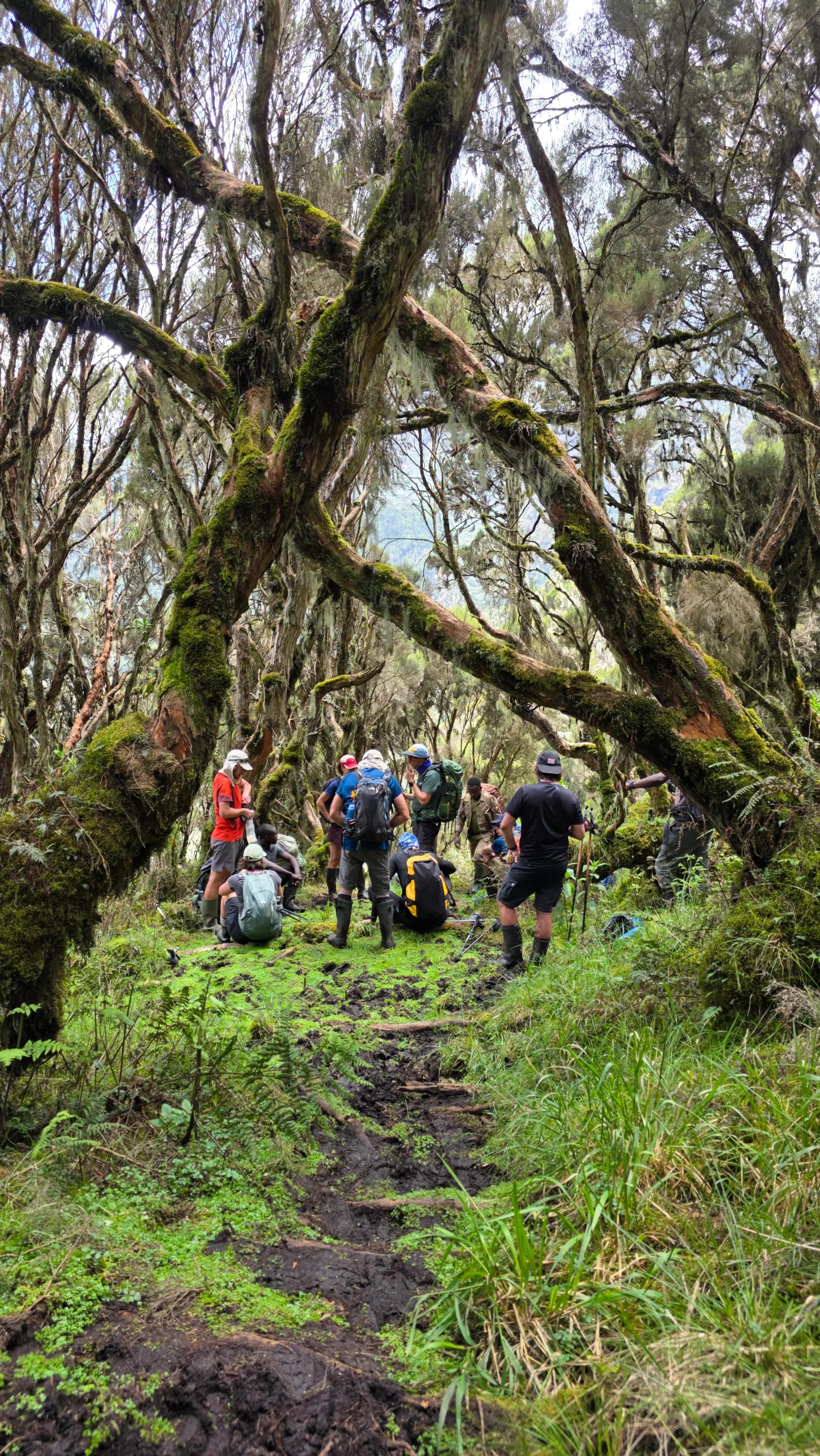
The Bukurungu Trail is the newest and most adventurous route to Margherita Peak (5,109 m), Uganda's highest point and the third-highest mountain in Africa. This 7-day, 6-night expedition offers a true wilderness experience through the remote eastern side of the Rwenzori Mountains before joining the Central Circuit for the summit and descent. Beginning in Omukolukumi Village, the trail passes through local communities, montane forest, bamboo, giant heather, expansive bogs, alpine valleys, and glaciers, with highlights including Mugule Pass, Lake Mugule, the Portal Peaks, and the iconic Bigo Boardwalks. Designed for experienced hikers and adventurous travellers, the Bukurungu Trail is renowned for its rugged terrain, long trekking days, and technical summit ascent. Summit day begins before dawn from Elena Camp, where climbers use ropes and crampons to cross the Stanley and Margherita Glaciers before reaching the summit at sunrise. Challenging, remote, and incredibly rewarding, this expedition showcases the very best of the Rwenzori Mountains and delivers one of the finest mountaineering experiences in Africa.
The Bukurungu Trail is the newest and most adventurous route to Margherita Peak (5,109 m), offering a remote wilderness experience through the eastern side of the Rwenzori Mountains before descending via the Central Circuit. The trail passes through local communities, montane forest, bamboo, heather, and semi-alpine vegetation, with highlights including Mugule Pass, Lake Mugule, the iconic Bigo Boardwalks, and Elena Camp, the base for the summit attempt. Renowned for its extensive bogs, river crossings, and technical glacier ascent using ropes and crampons, the Bukurungu Trail is a demanding expedition that showcases the Rwenzori Mountains' diverse landscapes and rugged beauty.
The history of the Rwenzori Mountains is deeply tied to exploration, geography, and local heritage. Ancient Greek geographer Ptolemy referred to a distant snow-covered range in equatorial Africa as the “Mountains of the Moon,” and many historians believe he was describing the Rwenzoris. For centuries, the mountains remained largely unknown to outsiders due to their remoteness and dense forests. European exploration intensified in the late 19th century during the search for the source of the Nile. In 1888, explorer Henry Morton Stanley became one of the first Europeans to document the range extensively, confirming the existence of permanent snow near the equator. The mountains later became an important symbol of Uganda’s natural heritage. In 1991, the Ugandan section was gazetted as Rwenzori Mountains National Park, and in 1994 it was recognized as a UNESCO World Heritage Site. Today, the Rwenzoris are celebrated both for their ecological importance and their role in Uganda’s tourism and conservation efforts.
The Rwenzoris are wrapped in myths and legends that reflect their awe-inspiring presence. Local communities have long viewed the mountains as sacred and mysterious places where spirits and ancestral powers dwell. One common legend says the peaks are the resting place of powerful spirits who control rain, fertility, and the well-being of nearby communities. The frequent mists and sudden storms are often interpreted as signs of spiritual activity. Some stories describe the glaciers as the “white beards” of ancient gods watching over the land. The name “Mountains of the Moon” itself has fueled centuries of imagination. Ancient travelers believed the mountains were a mythical source of great rivers and hidden wealth. Even today, the Rwenzoris carry an almost mystical reputation among climbers, who often describe the range as otherworldly because of its cloud forests, giant plants, and ever-changing weather. These legends are not merely folklore; they continue to shape how many local people relate to the mountains, treating them with reverence and respect.
UWA park fees included in price. Rates differ by nationality as set by Uganda Wildlife Authority.
or send an inquiry without signing in