
Mountains
At 4,890 metres, Mount Speke is where dramatic rock, wild weather and the heart of the Rwenzori come together.
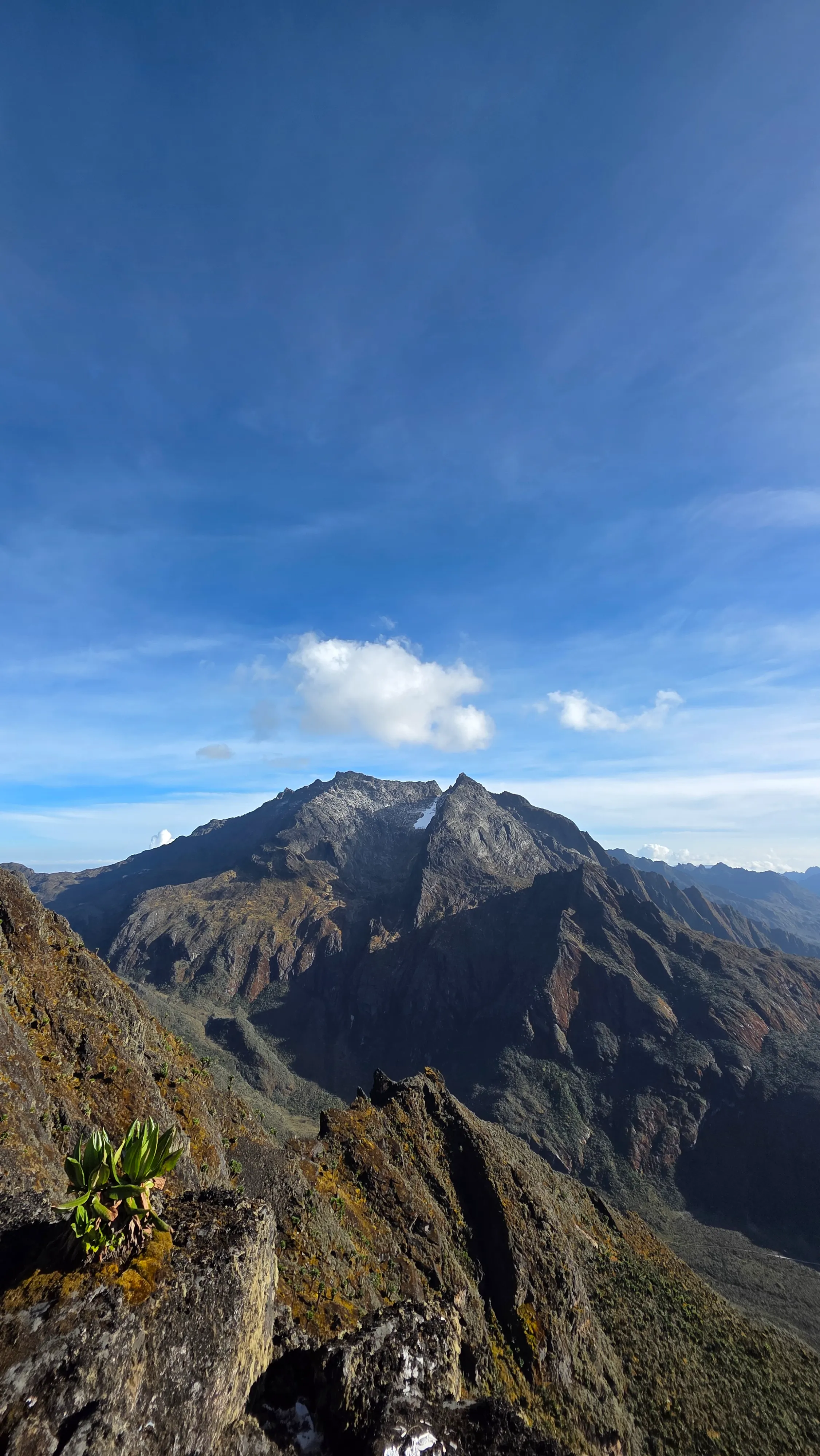
Mount Speke is one of those Rwenzori mountains that doesn't get nearly as much attention as Margherita, yet it has a fascinating story of its own. At 4,890 metres, it is the second-highest mountain in the Rwenzori range and rises dramatically above the Bujuku Valley, surrounded by Mount Stanley and Mount Baker. The mountain itself is made up of several peaks, including Vittorio Emanuele, Ensonga, Johnston and Trident, making it much more than just one summit.
The name Mount Speke comes from John Hanning Speke, the British explorer associated with the 19th search for the source of the Nile. But the history of this mountain goes much further than the names given to it by European explorers. The Bakonzo people had lived around the Rwenzori for generations and already had their own names, stories and understanding of the mountains. Later, in 1906, the Italian Duke of Abruzzi led a major scientific and mountaineering expedition into the Rwenzori. With his guides, scientists, porters and photographer Vittorio Sella, the expedition climbed many of the major peaks and produced some of the earliest detailed photographs and maps of the range.
One of the most interesting parts of the story is that the mountain's individual peaks carry names connected to that expedition. Vittorio Emanuele, the highest point of Mount Speke, was climbed by the Duke of Abruzzi and his guides on 23 June 1906. Imagine doing that in 1906, with none of the modern equipment we take for granted today. No GPS, no lightweight technical clothing and no weather apps telling you what was coming. They had to deal with the same unpredictable Rwenzori weather that climbers experience today: clouds, rain, snow, hail and sudden changes in visibility.
What makes Speke even more fascinating is the landscape around it. From Bujuku Valley, the mountain rises above a strange world of giant groundsels, lobelias, bogs and enormous rocky walls. You can be walking through completely tropical vegetation and then look up at a mountain approaching 5,000 metres. That contrast is one of the things that makes the Rwenzori so unique. Speke is also not a volcanic mountain like some of Africa's other famous peaks. The Rwenzori is an ancient mountain block formed by geological uplift, which is why its landscape is dominated by huge rock faces, valleys, ridges and high-altitude peaks rather than volcanic cones.
Today, Mount Speke remains one of the most impressive mountains in the range, but for me, its importance goes beyond its 4,890-metre summit. It carries the history of exploration, the knowledge and traditions of the people who have lived around the Rwenzori, and the incredible story of how the outside world began to understand these mysterious mountains. When you stand in Bujuku Valley and look up at Speke disappearing into the clouds, you're not simply looking at another mountain to climb. You're looking at a piece of the history and soul of the Mountains of the Moon.