
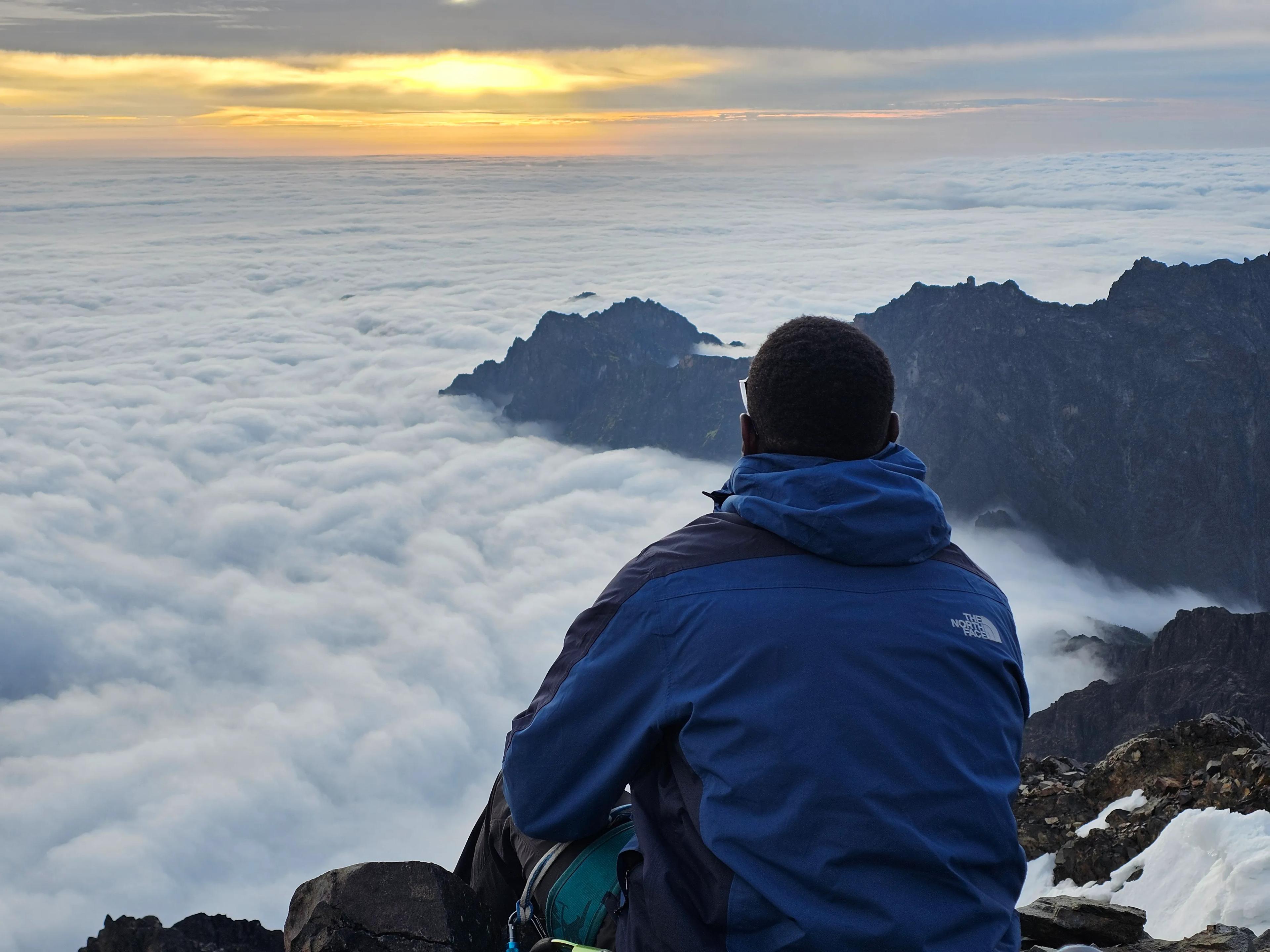
After 10+ expeditions into the Rwenzori Mountains, I've learned that success starts long before you reach the trailhead. Here are the lessons every climber should know before taking on Africa's toughest mountain range.
After many expeditions into the Rwenzori Mountains, I've learned that success starts long before you reach the trailhead. The Rwenzori is not just another hiking destination, and if you're planning to climb it, there are a few things you need to understand before you even start packing your bag.
The Rwenzori Mountains are often described as Africa's toughest mountain range, and there is a good reason for that. The altitude, long hiking days, steep climbs and descents, deep bogs, unpredictable weather, cold temperatures, difficult terrain and remote sections of the mountain all make this a serious expedition.
And when you're going for Margherita Peak, things become even more serious. You can encounter rock, snow, ice, fixed ropes and glacier terrain. This is not a mountain you should approach casually.
Here are some of the biggest lessons I've learned from my many expeditions into the Rwenzori.
1. IF YOU'VE NEVER DONE A MULTI-DAY MOUNTAIN, START THERE FIRST
One of the biggest mistakes I see is people making the Rwenzori their first serious multi-day mountain.
I wouldn't recommend it.
Before coming to the Rwenzori, try to do at least one proper multi-day mountain expedition. Even better, choose a mountain that takes you above 4,000 metres. Kilimanjaro and Mount Elgon are good examples of the kind of experience that can help prepare you.
The reason is simple. A multi-day mountain teaches you things that you cannot really learn from a one-day hike. You learn what it feels like to sleep on a mountain, wake up tired and start hiking again. You learn how your body responds to altitude, how to manage your food and water, how to deal with changing weather and, most importantly, how you perform when the excitement of the first day is gone and you still have several days ahead of you.
The Rwenzori demands that you keep moving even when you're tired, cold, wet or uncomfortable. Having already experienced that on another mountain can make a big difference.
2. UNDERSTAND WHAT YOU ARE SIGNING UP FOR
The Rwenzori is beautiful, but it is also demanding.
You can start the expedition walking through thick forest and beautiful vegetation, then find yourself in completely different terrain a few days later. The higher you go, the more the environment changes. You may deal with mud, bogs, steep sections, cold temperatures, rain, hail, snow and, depending on the route and conditions, very difficult terrain.
The altitude is another major factor. You are not just climbing high; you are spending several days at altitude while continuing to gain elevation.
And then there is the remoteness.
If something goes seriously wrong on the mountain, getting help is not as simple as calling an ambulance and waiting by the roadside. Communication can be limited, the terrain is difficult and rescue teams have to physically make their way to you.
That is why I always tell people to take the Rwenzori seriously. Enjoy the mountain, but never underestimate it.
3. PREPARE YOUR MIND FIRST
Physical fitness is important, but your mind can make or break your expedition.
I remember my first Rwenzori expedition. At that time, I had only been mountaineering for about a year, and I had already heard so many stories about how difficult the Rwenzori was. The mountain had a reputation that honestly made me nervous before I even arrived.
The Bukurungu Trail especially intimidated me. I had heard enough stories about the bogs and difficult sections to start imagining the worst.
But once I was actually on the mountain, something changed. The more I saw, the more curious I became. The landscape kept changing, and instead of only thinking about how difficult the mountain was, I started appreciating where I was.
That experience taught me something important. You need to prepare your mind for the mountain just as much as you prepare your body.
There will be moments when you are tired, wet, cold and wondering how much further you have to go. You have to be comfortable with being uncomfortable.
4. BUILD YOUR FITNESS
You don't need to be an elite athlete to climb the Rwenzori, but you need to arrive prepared.
The biggest mistake is preparing only for one long hiking day. The Rwenzori is different because you're not just hiking for one day. You are hiking for several consecutive days, often on difficult terrain.
Your training should therefore include long walks, hiking on uneven ground, climbing stairs, uphill work and activities that strengthen your legs and core.
More importantly, get used to training when you're already tired. One of the best ways to prepare for a multi-day expedition is to occasionally have back-to-back training days.
You want your body to understand what it feels like to wake up tired and still perform.
5. LEARN ABOUT ALTITUDE BEFORE YOU ARRIVE
Altitude sickness is something every Rwenzori climber should understand before starting the expedition.
Headaches, dizziness, nausea, unusual tiredness, loss of appetite and difficulty sleeping can all be warning signs. More serious altitude-related conditions can become life-threatening.
The important thing is not to hide how you are feeling.
I've seen people try to convince themselves that they are fine because they don't want to stop or because they are determined to reach the summit. That can be a dangerous decision.
If you feel unwell, tell your guide immediately.
The Rwenzori is remote and rescue can take time. Depending on where you are on the mountain, rescue can take at least 3 hours and, in some situations, up to 12 hours. Helicopter rescue is not an option because of the rugged terrain and mountain conditions. A rescue team has to travel to where you are.
That is why ignoring symptoms is never worth the risk.
The summit is not more important than your life.
6. PACK THE RIGHT GEAR
Packing for the Rwenzori is different from packing for an ordinary hike.
You need to prepare for rain, cold, mud, changing temperatures and the possibility of very difficult terrain. At the same time, you need to keep your pack light because there is a weight limit for porter-carried luggage.
At Outdoorsy Uganda, the porter-carried duffel is limited to 12.5kg. Your daypack is separate.
One thing I always emphasise is to pack what you actually need. Don't carry unnecessary weight just because you think you might use something.
Your footwear is also extremely important. Gumboots are used for a large part of the Rwenzori expedition because of the boggy and wet terrain. Ideally, your gumboots should be knee-high, or just below the knees.
When it comes to summit day, your gear becomes even more important because the conditions can be completely different from what you experienced lower down.
7. LEARN BASIC ROCK MOVEMENT
If you're planning to summit Margherita Peak, having some basic experience with rock movement can be very useful.
You don't need to arrive as a professional climber, but you should be comfortable moving on steep and rocky terrain and using your body properly when climbing.
There are sections where ropes are involved, and on Mount Stanley you will encounter technical sections where you need to understand how to move safely.
At Outdoorsy Uganda, our guides provide the technical equipment required for the climb, including ice axes, crampons, harnesses, helmets, carabiners, safety ropes, slings, lanyards and other equipment depending on the section.
You are also taught how to use the equipment before you reach the glacier and technical sections.
Still, having some basic rock-climbing experience before the expedition can make the experience much easier.
8. GET READY TO LISTEN TO YOUR GUIDES
This one sounds obvious, but I learned it the hard way. Be Humble, do as guide says.
During one expedition, a guide told me to step exactly where he was stepping. I decided I knew better and stepped somewhere else.
I immediately sank into a bog almost up to my knee.
That was enough of a lesson for me.
The guides spend a lot of time on these mountains. They understand the terrain, the weather, the routes and the places where you need to be careful.
When your guide tells you where to step, how to move or when to stop, listen.
Sometimes the small instructions are the ones that keep you safe.
9. RESPECT THE MOUNTAIN
The Rwenzori rewards preparation, but it also punishes overconfidence.
You can be extremely fit and still struggle with altitude. You can have all the right equipment and still get caught in bad weather. You can be an experienced hiker and still make a mistake in difficult terrain.
The mountain does not care how many hikes you have done before.
That's why I believe the best climbers are not necessarily the people who think they can handle everything. They are the people who know when to slow down, when to ask for help and when to turn back.
There is no shame in respecting the mountain.
FINAL THOUGHTS
The Rwenzori is one of the most incredible places I have ever experienced, but it is not a mountain I would tell someone to approach casually.
If you are planning to climb it, prepare properly. Build your fitness, prepare your mind, understand altitude, pack carefully and learn some basic mountain skills. If you have never done a multi-day mountain before, start somewhere else first, and ideally get experience above 4,000 metres before taking on the Rwenzori.
Most importantly, understand that this is a serious mountain.
You are going into a remote environment where the weather can change quickly, the terrain can be difficult and rescue can take hours.
But with the right preparation, the right team and the right mindset, the Rwenzori can also become one of the most rewarding experiences of your life.
Prepare for the mountain before the mountain tests you.
Ready to experience this yourself?
View Expedition Calendar